The problem we set out to solve
Permanent magnet synchronous machines are the default choice for electric-vehicle motors because of their efficiency and power density. Their weak point is speed range: a machine wound and tuned for efficiency at typical driving speeds eventually reaches the inverter’s voltage limit as its back electromotive force rises.
The two usual solutions both impose a cost. Field weakening extends speed by injecting current to oppose the motor’s magnetic field, but consumes additional energy and reduces high-speed efficiency. A mechanical gearbox also extends the operating range, but adds mass, cost, mechanical loss, and another component that can fail.
We wanted to extend a PMSM’s efficient speed range without paying either of those penalties.
The core idea
Our answer, called an e-gear, lets the motor change its internal winding configuration while operating. The machine effectively shifts gear electrically rather than through a mechanical transmission or by fighting its back-EMF.
- Series for torque, parallel for speed. Connecting the windings in series favors torque and low-speed operation. Reconnecting them in parallel effectively halves the voltage seen by each winding at a given speed, allowing the motor to spin faster before reaching the inverter’s voltage ceiling. Together, the two configurations can double the efficient speed range.
- Mechanical relays perform the switching. Simple relays make and break the series and parallel connections instead of power-semiconductor switching networks. Their low closed-contact losses keep the reconfiguration hardware efficient, straightforward, and comparatively inexpensive.
- Bifilar windings make the concept broadly applicable. Motors with suitable pole and slot combinations may already provide parallel paths with matching back-EMF. For other machines, winding two parallel strands together creates the required paths regardless of slot or pole count.
- A controlled sequence manages the handoff. The drive triggers the relays, waits for contact movement and bounce to settle, then resumes control using parameters for the new winding configuration. This sequence keeps the transition safe and controlled while the motor is rotating under load.
What we tested
We validated the concept in simulation and on a 4 kW axial-flux PMSM. The simulation modeled the machine as a six-phase system in the standard reference frame so that transient behavior during winding reconfiguration could be captured accurately.
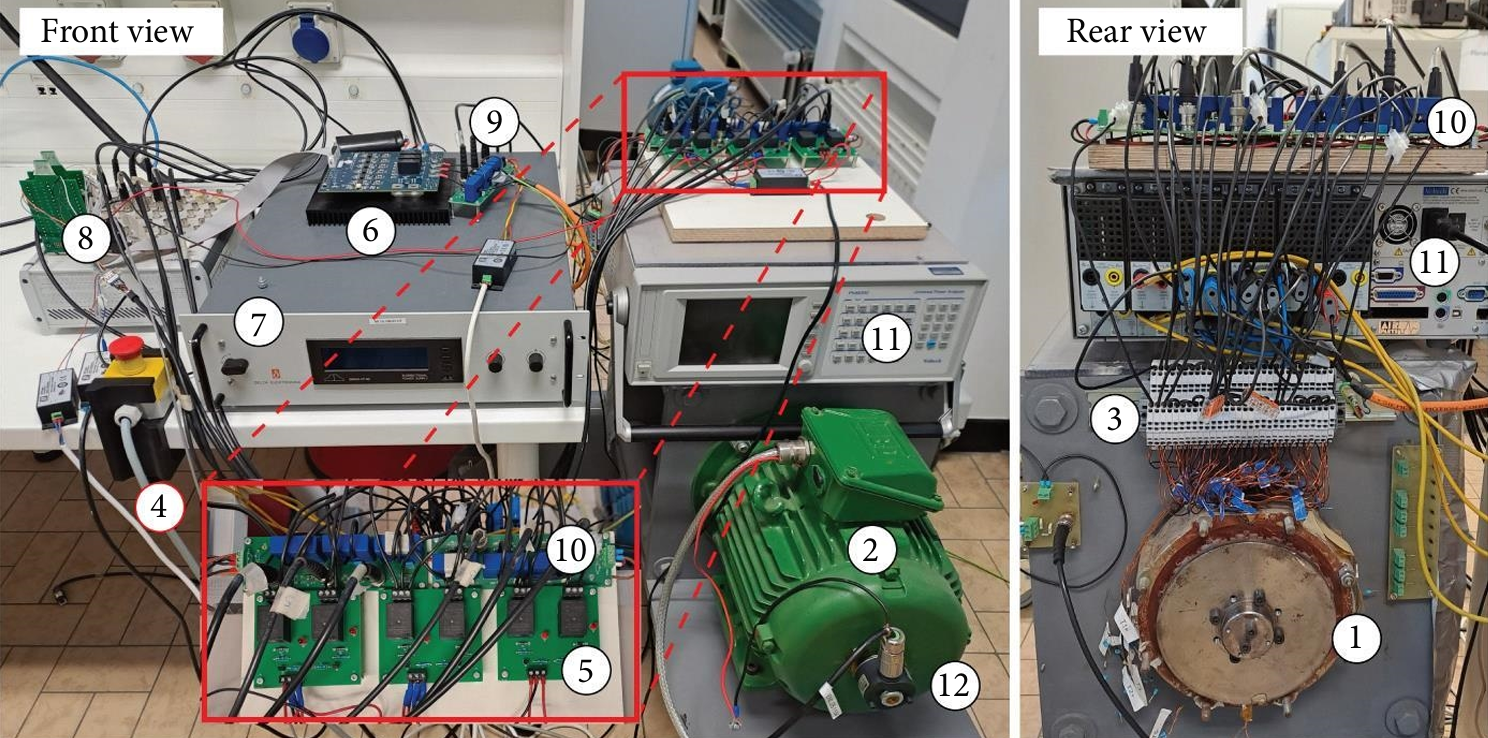
In the experimental system, both series-to-parallel and parallel-to-series reconfiguration were completed in under 35 milliseconds while the machine was running, confirming that the e-gear is practical rather than only a theoretical concept.
Why this matters
Extending a PMSM’s efficient speed range usually means accepting either the energy penalty of field weakening or the mass, loss, and complexity of a mechanical gearbox. An e-gear based on ordinary mechanical relays offers a third option: it doubles the efficient speed range by reconfiguring the motor’s own windings, with a demonstrated switching time fast enough for drivetrain use.
For electric-vehicle powertrains where efficiency and added mass both matter, this provides a meaningfully different solution to a longstanding motor-drive limitation.