The problem we set out to solve
Renewable and distributed energy sources such as photovoltaic panels and fuel cells typically produce relatively low voltage. Before they can feed a DC bus, inverter, battery system, or charging station, that voltage often needs to be stepped up substantially.
Giving every source its own converter works, but a multisource system quickly becomes a collection of separate switches, inductors, and control loops. Multi-input converters combine those sources in one shared power stage, yet existing designs frequently suffer from switch-voltage spikes, high-ripple input current, excessive component count, extreme duty cycles, or a fixed number of inputs.
We set out to create a converter that could deliver high voltage gain, draw smooth current from every source, use fewer components, and scale to as many inputs as the energy system requires.
The core idea
The converter combines coupled inductors and voltage-multiplier cells in a current-fed structure, with refinements that address the usual drawbacks of both techniques.
- It is built to grow. Each source connects through a repeatable cell consisting of an inductor, coupled inductor, diodes, and capacitors. A third, fourth, or fifth source can be added without redesigning the existing inputs or their control.
- It achieves high gain at moderate duty cycles. Coupled inductors and multiplier cells work together to produce a high output voltage without forcing the switches toward extreme duty cycles and excessive conduction loss.
- It reduces switch stress. Both power switches turn on under zero-current switching, while leakage energy is recycled into the circuit instead of producing destructive voltage spikes. The switches therefore see only a fraction of the output voltage.
- It soft-switches the output diode. Resonant operation on the coupled-inductor primary sides lets the output diode turn off under zero-current conditions, reducing reverse-recovery loss and stress.
- It keeps source current smooth. The current-fed input inductors maintain continuous, low-ripple current, which is well suited to photovoltaic panels and fuel cells.
What we built and tested
A 550 W, two-input prototype with 18 V and 24 V sources was built to validate the design.
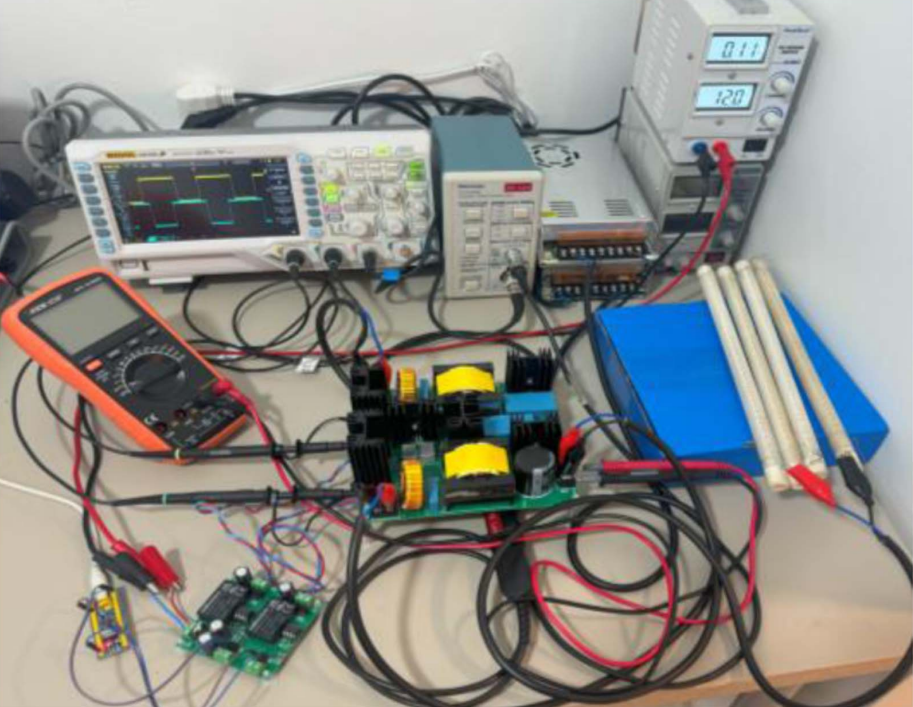
- At a duty cycle of 0.6 and coupled-inductor turns ratio of 2.3, the prototype boosted the two low-voltage inputs to approximately 390 V, closely matching the theoretical gain.
- Measured input currents were continuous with low ripple, while output-voltage ripple remained small.
- Both switches demonstrated zero-current turn-on. The output diode and one internal diode achieved zero-current switching at turn-on and turn-off.
- Switch voltage stresses were approximately 75 V and 52 V despite the roughly 390 V output, enabling lower-voltage and potentially lower-cost MOSFETs.
- The converter handled a load step from 320 W to 550 W and back cleanly.
- Detailed loss modeling produced a calculated full-load efficiency of 97.07%, and measured efficiency increased steadily with output power while tracking the theoretical curve.
- Closed-loop controllers designed through frequency-response and Bode analysis remained stable and responded well to disturbances.
Why this matters
Compared with several recently published multi-input, high-step-up converters, this design uses fewer switches, diodes, and capacitors while providing higher voltage gain for a given duty cycle and low combined switch-voltage stress. A comparable fixed two-input design cannot be extended, which is the specific gap this work addresses.
As energy systems combine solar arrays, fuel cells, batteries, and other sources, an efficient converter platform that grows by adding an input cell—rather than another complete converter—can reduce complexity, preserve source-friendly current waveforms, and support cleaner multisource power conversion.