A compact, multi-source EV powertrain interface
Electric vehicles increasingly need to coordinate grid charging, rooftop photovoltaic generation, fuel-cell support, vehicle-to-grid operation, and regenerative braking. Conventionally, each capability adds a dedicated converter, increasing weight, cost, volume, and system complexity.
This work asks whether a single power circuit can manage these sources and operating modes without separate hardware for each one. The proposed charger combines an integrated motor-based front end with a reconfigurable multiport buck-boost converter.
1. Reusing the motor windings
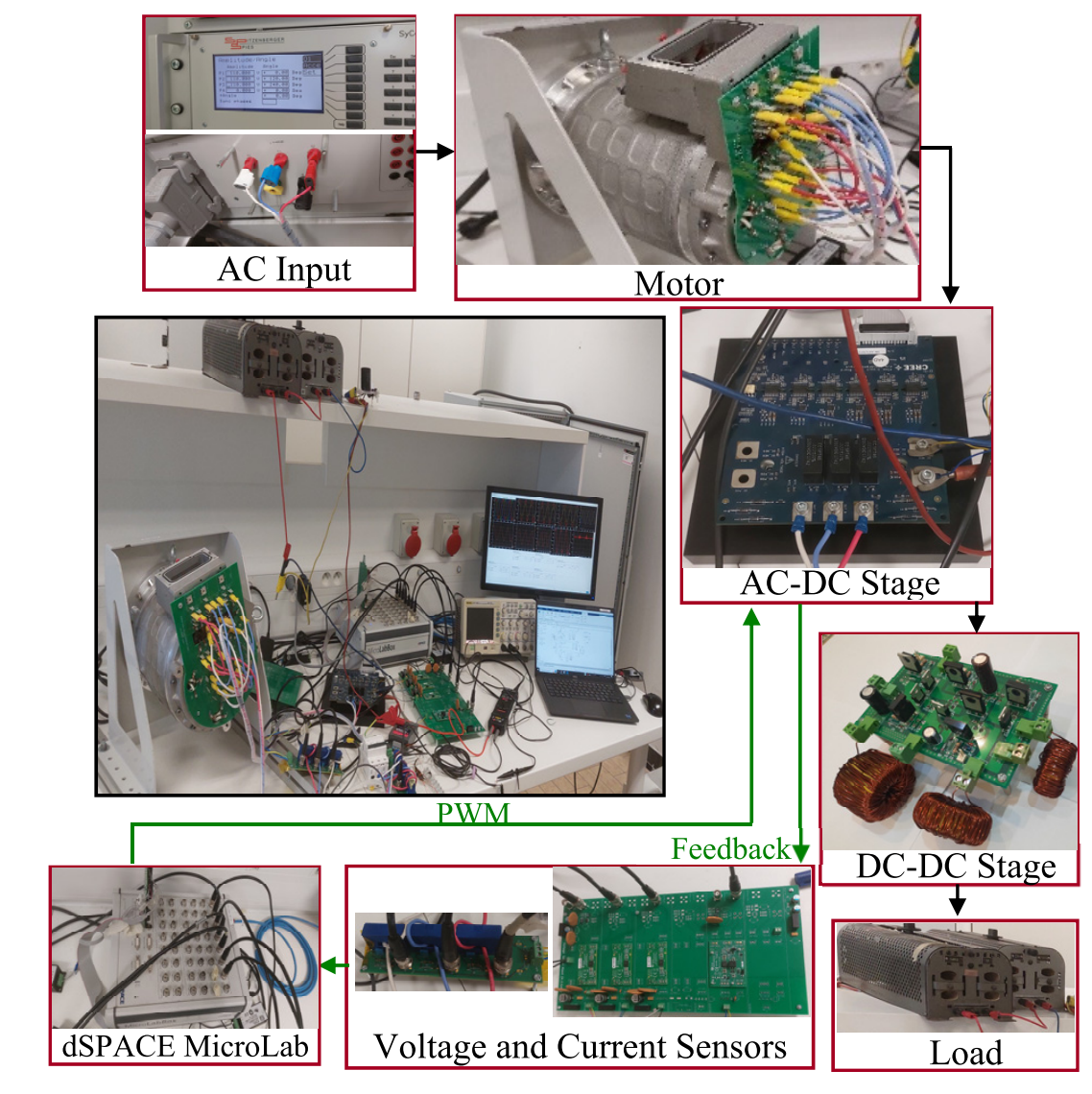
When the vehicle is parked, the traction-motor windings are available. The design uses them as the input inductor for the power-factor-correction stage, avoiding a separate bulky inductor. Connecting the three phases at the motor star point creates an equivalent input inductor while equal phase currents produce zero torque, so charging can occur without wheel motion or a mechanical lock.
2. One reconfigurable buck-boost stage
A Cuk-based multiport DC–DC converter connects the grid, photovoltaic panel, fuel cell, and battery through the same switching hardware. Its switching pattern adapts to the active sources and operating mode; no physical reconfiguration is required.
- Grid charging, including grid-plus-PV and grid-plus-PV-plus-fuel-cell operation
- Charging from PV or fuel-cell sources alone
- Driving, vehicle-to-grid operation, and regenerative braking
The buck-boost architecture can step voltage up or down between ports, allowing the grid, PV source, fuel cell, and battery to operate at different voltage levels.
Experimental validation
A 500 W prototype was tested with a three-phase motor and dSPACE real-time control. The AC–DC stage achieved clean sinusoidal, unity-power-factor grid current and approximately 93.6% efficiency at the tested operating point. In the most demanding simultaneous grid, PV, and fuel-cell charging mode, the DC–DC stage achieved 94.2% efficiency.
- Battery, PV, and fuel-cell voltages were regulated to their targets.
- Vehicle-to-grid operation delivered a clean current waveform from the battery to the grid.
- Simulation and efficiency mapping indicate efficiency above roughly 86% toward 2 kW and above 75% across a broad duty-cycle range.
Contribution
The charger extends the benefits of integrated charging by combining multiple sources and operating modes in a single, flexible architecture. It is designed to support simpler, lighter multi-energy EV powertrains without adding dedicated converters for each source or function.