The problem we set out to solve
A hybrid microgrid combines an AC subgrid—such as wind turbines and AC loads—with a DC subgrid containing solar PV, batteries, fuel cells, and DC loads. A critical interlinking converter manages all power flow between them, so its design has a major effect on the microgrid’s cost, safety, and reliability.
A conventional single-phase AC/low-voltage-DC hybrid microgrid needs four wires: phase and neutral on the AC side, plus positive and negative on the DC side. Removing the isolation transformer saves cost, size, and losses, but it can create a low-impedance path between incompatible AC and DC grounding systems. The resulting problems include:
- Continuous leakage current through parasitic capacitance.
- Additional electromagnetic interference and accelerated component wear.
- A difficult grounding design problem whose solution depends on the AC subgrid.
- The need for an extra DC/DC boost stage in many non-isolated converter designs before they can connect to a low-voltage DC subgrid.
The core idea
We gave the AC subgrid’s neutral and the DC subgrid’s negative terminal a shared common bus, reducing the system from four wires to three.
- Fewer wires reduce cost. Combining AC neutral and DC negative removes one system wire without adding components.
- The grounding conflict disappears. Both subgrids share the same reference point by construction, so each side is properly grounded.
- Leakage current drops considerably. Keeping AC neutral and DC negative at the same potential largely eliminates the high-frequency common-mode voltage that drives leakage current, without extra switches, filters, or modulation techniques.
- Fault behavior improves. Mathematical models for positive-pole-to-ground, negative-pole-to-ground, and phase-to-ground faults show substantially lower semiconductor stress. Because the negative DC pole is already grounded, a negative-pole fault produces essentially no additional switch current.
- The converter remains bidirectional and flexible. The single-stage topology supports AC-coupled, DC-coupled, and fully bidirectional AC/DC-coupled microgrids.
The topology resembles a three-phase voltage-source converter, allowing us to adapt established space-vector modulation. A structural constraint keeps the reference vector within only three of the usual six sectors, simplifying the modulation method further.
What we built and tested
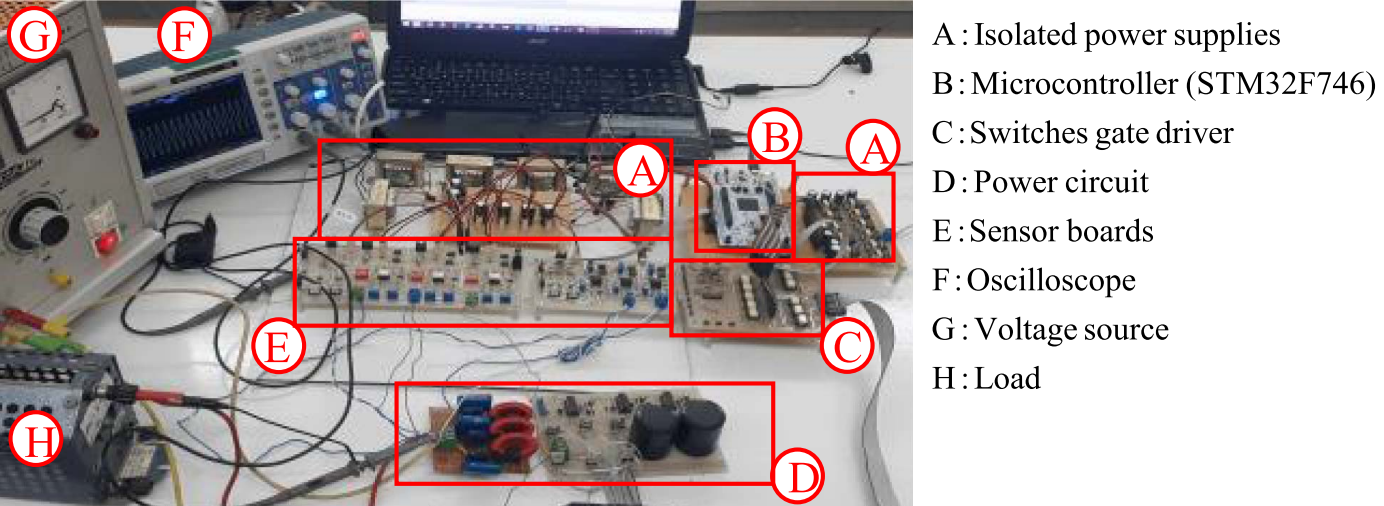
We validated the converter through detailed simulations of AC-coupled, DC-coupled, and bidirectional AC/DC-coupled microgrids, followed by a scaled experimental prototype for the DC-coupled case.
- During a positive-pole-to-ground fault, the conventional converter’s switches reached 160–505 A across the tested fault resistance range, while the proposed converter remained between 25 and 140 A.
- During a negative-pole-to-ground fault, the conventional converter reached 580 A, while the proposed converter experienced no additional overcurrent stress.
- During a phase-to-ground fault, the proposed converter also maintained lower peak switch current throughout the tested conditions.
- Average efficiency was approximately 97% ± 1%, with a peak of 98.6% at full load, compared with approximately 95.8% ± 1% average and 97.1% peak for the conventional design.
- All three simulated configurations regulated their AC and DC voltages, responded cleanly to load changes, and transferred real power bidirectionally as operating conditions changed.
- A scaled prototype with a 30 V DC source, 35 V AC reference, and 50 V common DC link confirmed dynamic regulation and improved fault ride-through behavior.
Why this matters
Every watt exchanged between the AC and DC sides of a hybrid microgrid passes through the interlinking converter. Sharing one reference wire is a small topological change that cuts wiring cost, resolves a difficult grounding problem, suppresses leakage current, and makes the system substantially more resilient to ground faults—without additional hardware or control complexity.
As hybrid AC/DC microgrids become more common in residential, commercial, and renewable-rich systems, that combination of lower cost, high efficiency, and improved fault behavior offers a practical route to safer and more reliable installations.